

Appreciating the Charm of Classical Chinese Poetry
To thoroughly implement Xi Jinping Thought on Culture, advance aesthetic education in the new era, and preserve China's outstanding traditional culture, the SDUT Poetry Society hosted a special lecture on December 5th entitled ‘Appreciating and Composing Classical Poetry: Commencing with the Book of Songs and the Lamentations’. This event was organised by the University Youth League Committee, hosted by the School of Literature and Journalism, School of Physical Education, and School of International Education, and co-organised by the University Poetry Society. Professor Li Yiyong, Party Secretary of the School of Literature and Journalism, and Vice President of the University Poetry Society, was specially invited as the keynote speaker.
The university placed great emphasis on this cultural education initiative, launching advance registration and promotional efforts. International students demonstrated exceptional enthusiasm and curiosity towards classical Chinese poetry, with overwhelming response to the event. Students eagerly sought this opportunity to experience the unique charm of China's outstanding traditional culture at close quarters.
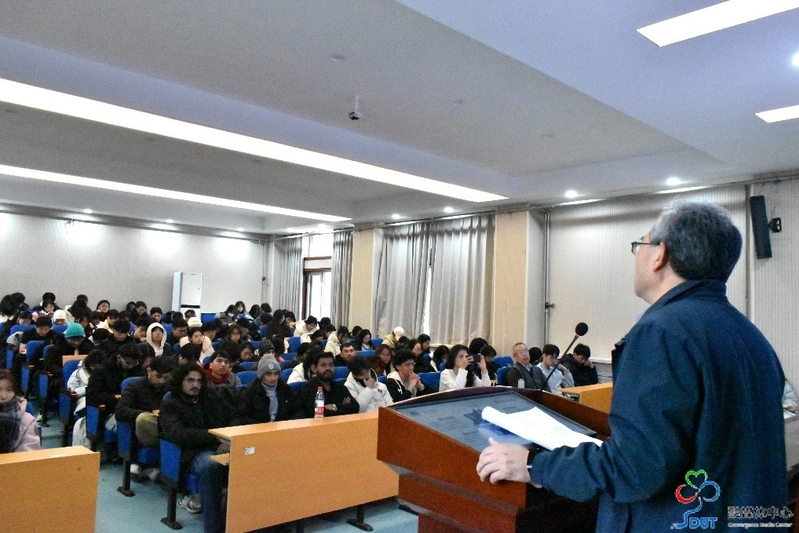
During the lecture, Li Yiyong delivered a systematic and vivid exposition on the allure of Chinese cultural poetry, the enduring legacy of Chinese verse, and the rhythmic structures of classical poetry. He traced the developmental trajectory from pre-Qin poetry to renowned Tang and Song dynasty works and modern masterpieces, while meticulously dissecting core poetic conventions such as tonal patterns and parallelism, thereby illuminating the creative principles of classical verse. Simultaneously, he shared his own poetic creations, using his personal creative journey to demonstrate the enduring vitality of traditional verse in contemporary times. This guided attendees in comprehensively appreciating the aesthetic value and compositional techniques of classical poetry.
This lecture not only constitutes a vital component of the university's aesthetic education initiative but also serves as a cultural bridge between Chinese and international students. It facilitates international students' deeper understanding of Chinese culture, advances the global dissemination of China's outstanding traditional culture, and further cultivates a campus atmosphere conducive to multicultural integration.
Shandong University of Technology 266 Xincun West Road,Zhangdian District, Zibo City, Shandong Province, P.R.China
E-mail:enroll@sdut.edu.cn
Tel:(86)0533-2787522
